Delivery stalls between the teams.
The teams are not the problem.
You reorganized. You installed the framework. You added a coordination layer. Two quarters later the same handoff is late again, because the structure is producing it on purpose.
The same feature, traced through two structures. On the left it crosses five system teams (platform, services, web, mobile) and waits in a queue at every boundary. On the right, one structural change: the boundaries the work kept crossing are gone, and so is the waiting.
One move from one engagement, not a universal prescription. Finding the move your structure needs is where we start.
What I keep seeing
Different sentences, one source. I show you the source, then your options for changing it.
“We hired forty more engineers and got slower.”
→ Every feature crosses five boundaries; coordination ate the new capacity.
“The framework worked for a quarter, then it all slid back.”
→ The conditions that produced the problem stayed; the system absorbed the reform.
“Our best people leave, and exit interviews say ‘culture’.”
→ The people who see across teams have nowhere to act on it, so they act on the job market.
“We’re solving the same problem we solved last spring.”
→ Incentives and planning cycles rebuild it after every fix: the structure is doing what it was built to do.
“Nothing moves without a decision from someone who isn’t in the room.”
→ Authority sits one layer above the information: every decision makes a round trip before the work resumes.
“Every team hits its targets and the product doesn’t move.”
→ The targets stop at each team’s boundary: the outcome that crosses them all belongs to no one.
Ways to work together
Not three sizes of the same engagement: a few days that end with your options in writing, a redesign carried out over months, or one session on one problem. Pick by the situation you are in.
“We could be developing product faster, and shipping more value. I have to decide what to change.”
Observations and Options
Two to three days inside your organization. We trace how work actually flows and name what produces the problem you keep re-solving. You get it in writing: the mechanism, its cost, and the ways forward, each with its own risk.
“We have licences, pilots and enthusiasm. Nothing about how we work has changed.”
AI adoption · H³
AI adoption fails in three structural patterns: over-controlled, under-controlled, and decisions that never stick. H³ is one redesign for all three: three days on site, then three to six months of real work with named owners. Then the cycle repeats.
“I don’t need a consultant. I need to get sharper at reading the system I’m inside.”
Mentoring
For practitioners and internal leaders. You bring one live problem from your own organization; we sharpen how you read the structure behind it. No subscription, no programme: one session when the problem is in front of you.
All three start the same way: a free 30-minute call where we work out which one fits. Doesn’t fit any of them? Bring the problem anyway. The call is where we find the shape that does.
Book the free call →Three ways to reach me →Where this has held
400 people regrouped around customer outcomes.
BeforeR&D organized by specialty. Every feature crossed five team boundaries. Product managers spent more time negotiating between teams than understanding customers.
AfterCoordination layers dissolved because the conditions that required them no longer existed. Teams now own their own hiring, promotions, and escalation.
Case study on less.works ↗The bank’s most critical system, developed as one product.
BeforeFive million lines of the system, owned component by component, in places by single individuals, each responsible for a fragment of the code. Integration was tested by hand; every release meant coordinating dozens of separate owners.
AfterA team of teams now develops it as one product, whole and end to end, with continuous integration as a way of working, not just a pipeline. The bank later adopted the approach company-wide as its Product Design Engineering model, which I co-designed.
Named reference available on request →Writing & talks
Thirty minutes tells us both whether this is worth doing.
Everything I do with a client starts here. We look at your situation together, and decide whether one of the three ways above fits it, or whether none of them does.
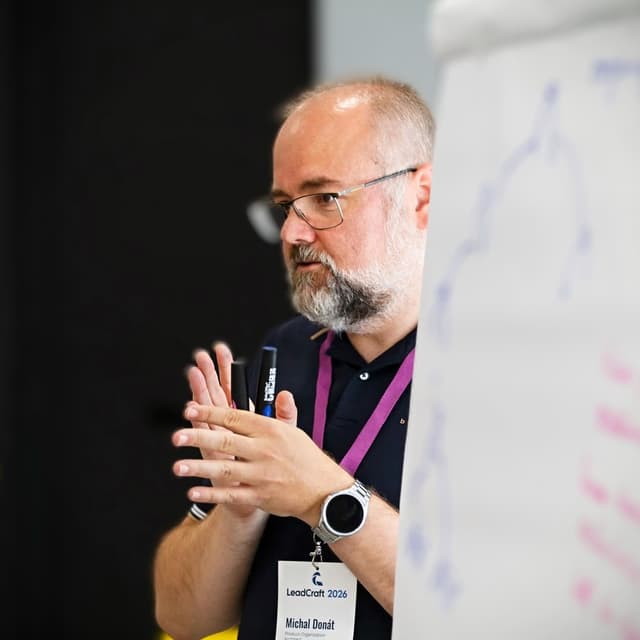
Fifteen years inside product organizations, watching them hit the same structural walls. This practice came from refusing to treat those walls as execution problems. I speak and mentor at LeadCraft, the LeSS Conference, Agile Prague and the Engineering Leaders Community.
For your conference or an internal event: Invite me to speak →